Struggling to see the profit in premium smart baby devices? The risk of unsold stock and complex regulations can kill your margins. A clear decision framework is the only answer.
Success with smart infant health trackers depends entirely on your specific context. You can increase margins if you align the product with your target customer, your brand strategy, and the regulatory rules of the market where you sell. It is not a one-size-fits-all upgrade.
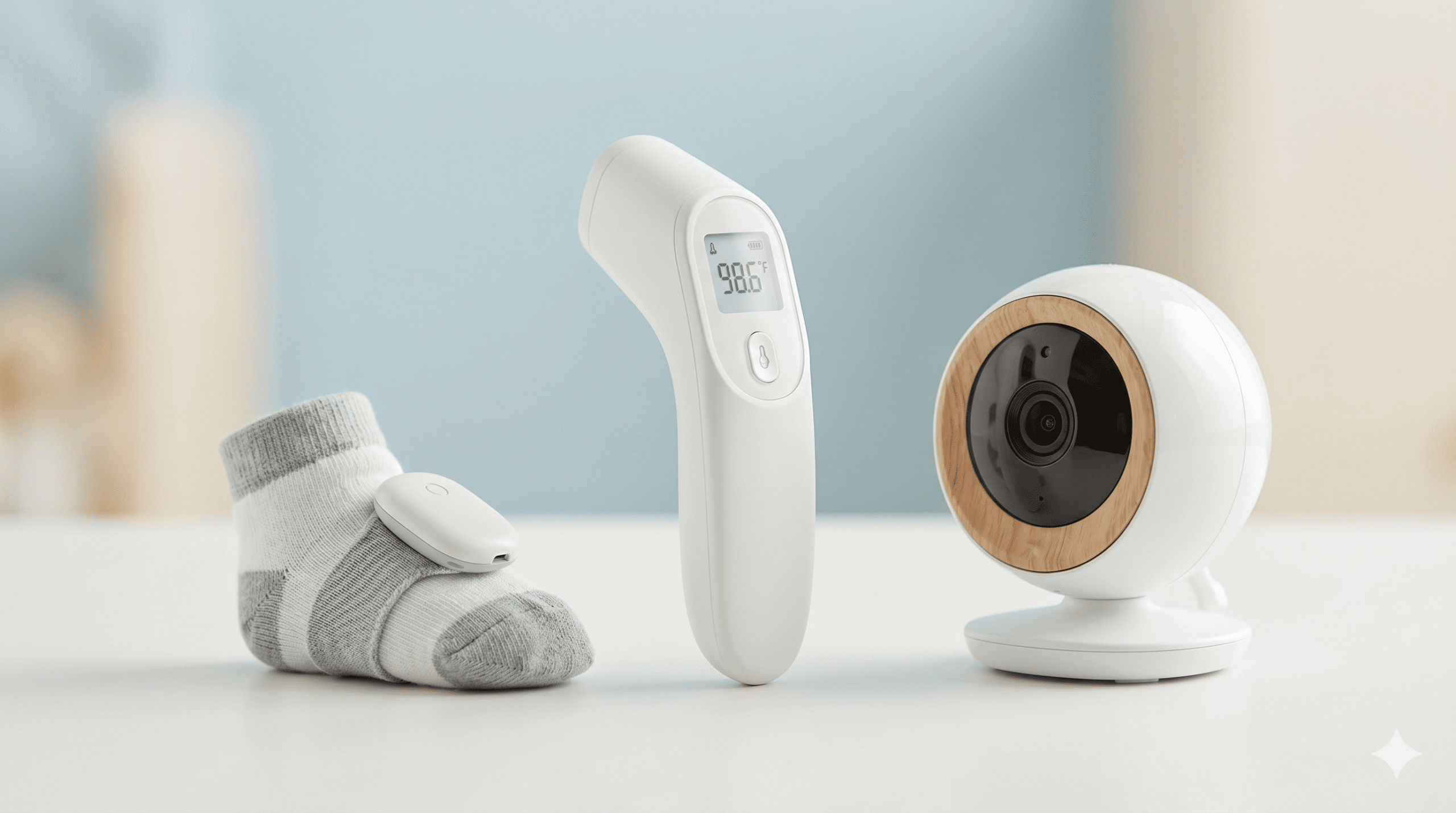
I get this question all the time from my B2B clients, whether they are supermarket purchasers or online brand owners. They see these sleek smart thermometers and baby monitors and want to know if the higher price tag is worth it. But the real discussion isn't just about the cost difference between a traditional product and a smart one. It's about understanding the entire business case from start to finish. Before we even talk about pricing, we have to talk about who you are selling to and what they really want. This brings us to the first critical question I always discuss with my clients.
Why Do Different Buyers See 'Premium' So Differently?
You assume a 'smart' label adds universal value. But supermarket and boutique customers have different priorities, making your pricing strategy a gamble. This misalignment can hurt your sales.
The word 'premium' is defined by your end customer's main need. Supermarket shoppers want convenience. E-commerce buyers seek brand trust. High-end customers pay for unique tech. Understanding this split is key to protecting your margins and setting the right price.
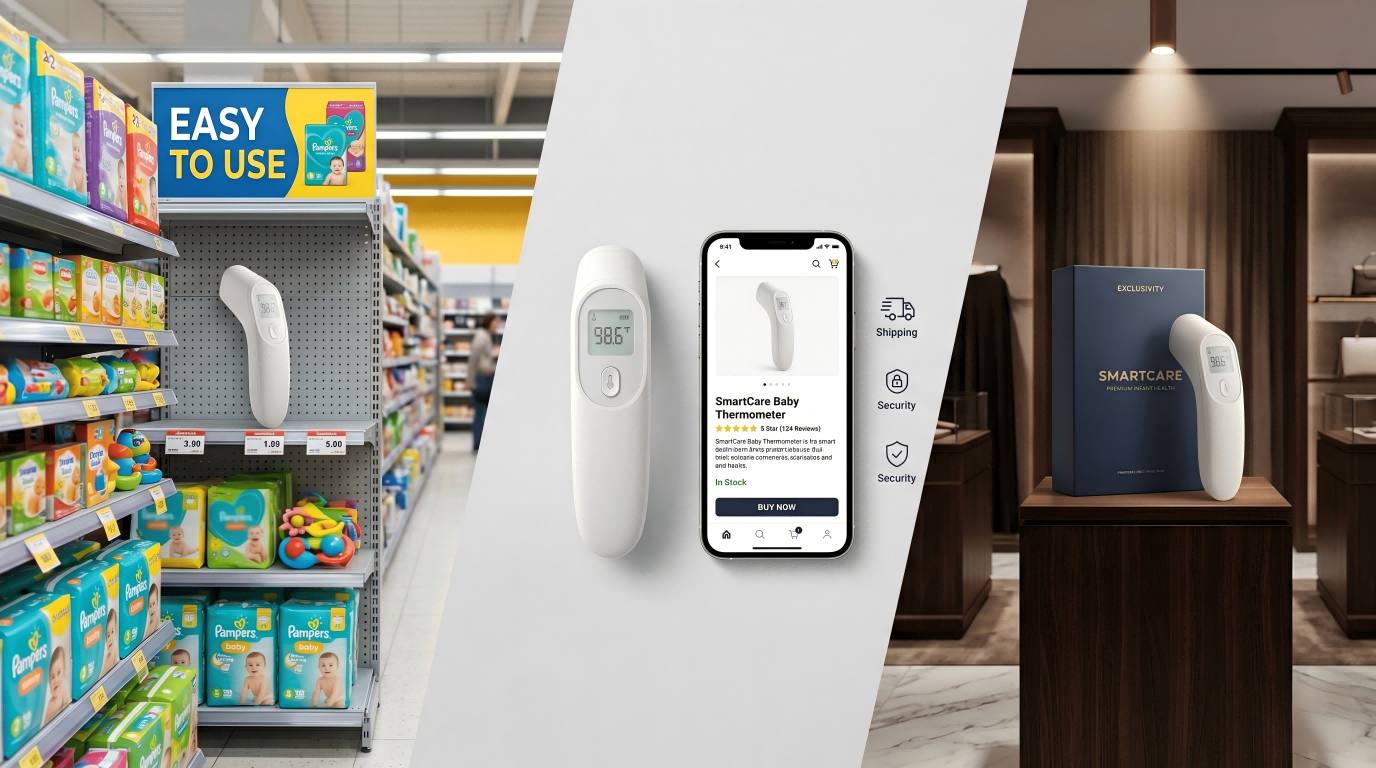
When a buyer for a large European supermarket chain asks me about a "smart" baby thermometer, I know what they are really asking for. They want a device that is simple, reliable, and won't cause customer service headaches. They aren't interested in a long list of features. Their end-customer is a busy parent who values convenience above all else1. In my experience, the premium they are willing to pay for is tied directly to simplicity and peace of mind. But this is completely different for an online brand partner who wants to build a high-end image. Their definition of "premium" is about technology and design. They need a product that stands out online.
To help my clients, I often break it down like this:
| Buyer Type | End-Customer's Main Priority | "Premium" Means... | Your Biggest Risk |
|---|---|---|---|
| Supermarket Purchaser | Convenience & Value | "It just works and saves me worry." | High return rates if the app is confusing. |
| Online Distributor | Brand Trust & Reviews | "It looks and feels like a trusted brand." | Negative reviews from poor app support. |
| ODM Brand Partner | Tech & Design Differentiation | "It has a feature no one else has." | The unique feature doesn't solve a real problem. |
The "light medical" positioning fits into this framework. For the supermarket, it adds a layer of perceived authority that justifies a slightly higher price. For the ODM brand, it might be a core part of their identity. But this positioning also triggers regulatory questions that you must be prepared for, especially in markets like the EU.
Are You Accounting for the Hidden Costs of Smart Devices?
You focus on the unit cost difference between traditional and smart items. But hidden costs in compliance, support, and returns are eating your profit. This oversight is a major financial risk.
Smart devices carry costs well beyond the factory price. You must budget for regulatory compliance, strong after-sales support for app issues, and higher inventory risk from fast-changing technology. These 'hidden' expenses directly impact your final margin and must be calculated from the start.
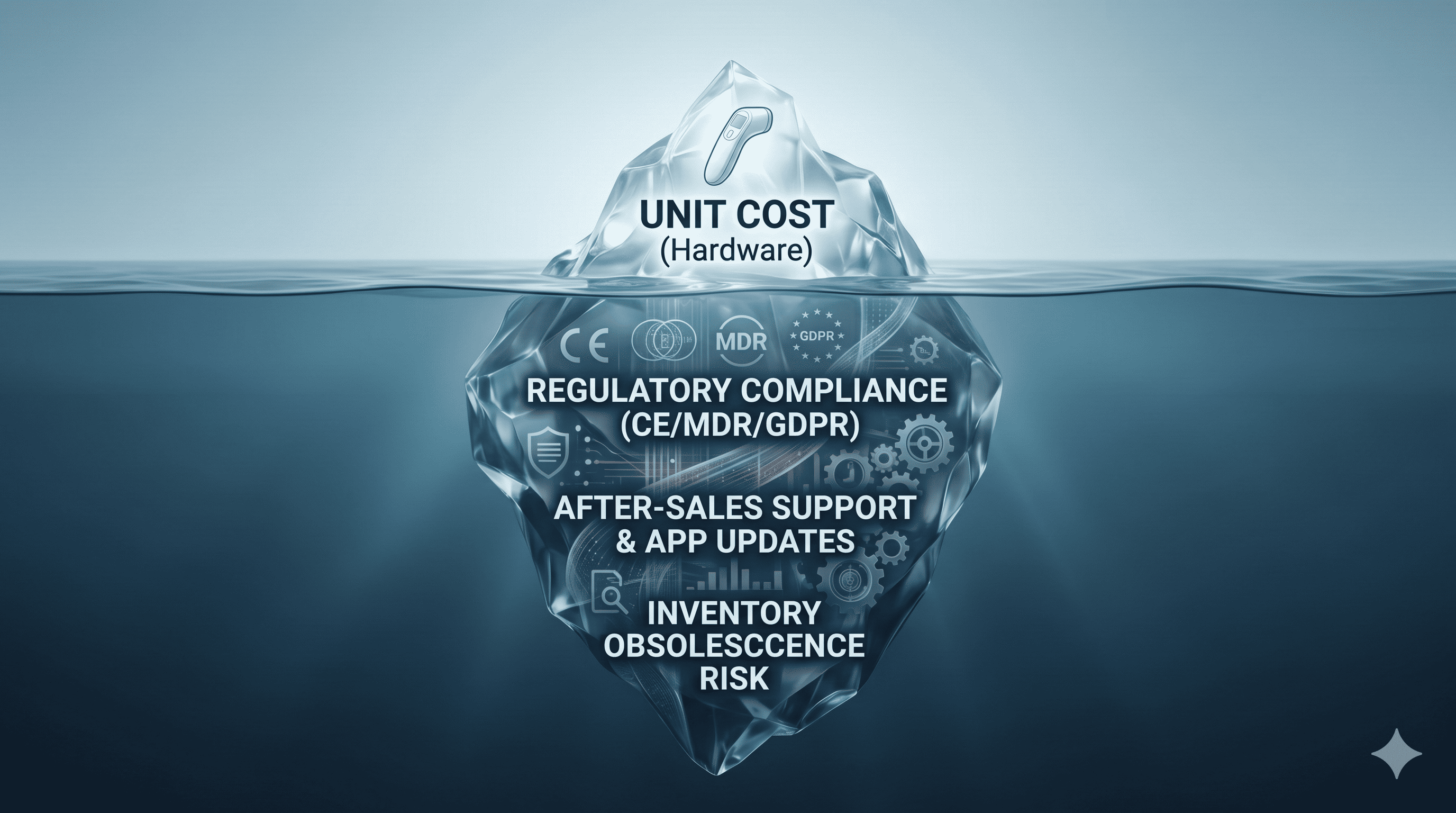
One of the most dangerous mistakes I see buyers make is a simple one. They look at a $2 traditional thermometer and a $15 smart one2 and assume the margin calculation is easy. They forget that the smart product is not just a piece of plastic; it's a service. This means its cost structure is completely different. A traditional product is simple. Its main cost is the unit itself. But a smart device brings a long list of new expenses that can quickly erase your profits if you are not prepared for them. I always push my clients to analyze these hidden costs before they place an order.
Here is a simple comparison I use to make the point clear:
| Cost Factor | Traditional Baby Product | Smart Health Tracker |
|---|---|---|
| Unit Cost | The main cost driver. | Just the starting point. |
| Compliance | Minimal (basic product safety). | Complex (CE, RoHS, data privacy, medical device rules3). |
| After-Sales Support | Low (replace if it breaks). | High (app troubleshooting, connectivity help, updates4). |
| Inventory Risk | Low (product is timeless). | High (technology becomes obsolete quickly5). |
These are not small details. For my clients selling in Europe, the "light medical" claim on a smart device might push it into a different regulatory category under the EU's Medical Device Regulation (MDR)6. This means more paperwork, more testing, and higher costs. It's my job to make sure they see the whole picture, not just the factory price.
How Do You Justify the Price Gap to Your Customers?
You're worried your customers will see your new smart baby monitor as an overpriced gadget. If you can't explain its value simply, it won't sell. This hesitation can stall your launch.
Do not sell the technical specs. Justify the price by answering the parent's real question: "How does this make my life easier or give me peace of mind?" Frame the value in simple benefits, like tracking fever trends for a doctor's visit7.
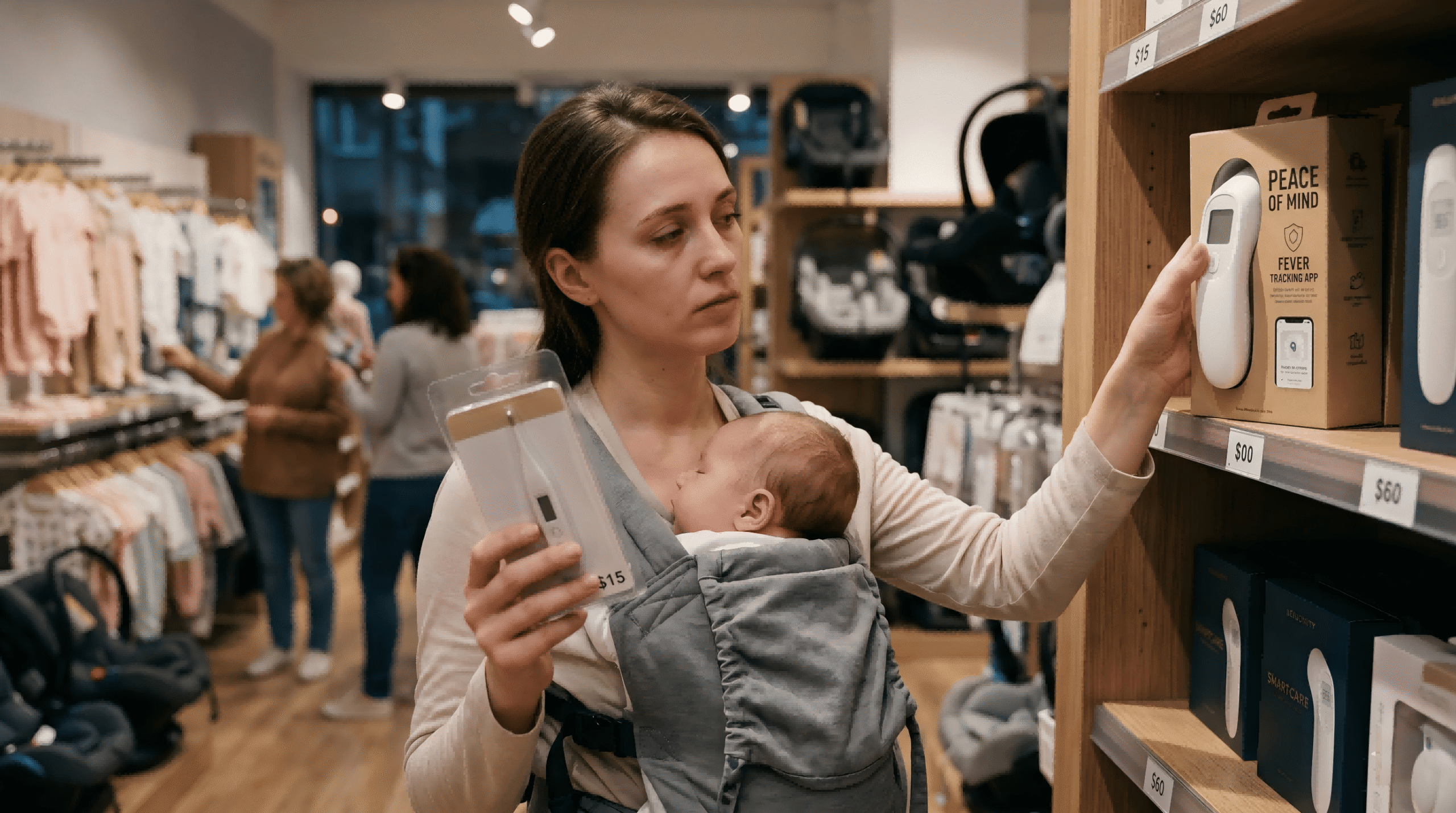
The most practical questions I get from buyers are not about sensor accuracy or battery life. They ask me, "What should the packaging say?" and "What do I tell my customer service team to do when a customer can't pair the app?" They are thinking about the last ten feet of the sale, in the store aisle or on the product page. They are thinking about returns. This is where the marketing story becomes critical. You cannot sell a smart health tracker by listing its technical features. You have to sell the benefit.
Frame the Benefit, Not the Feature
Parents are tired and stressed8. They don't have time to become technology experts. Your message must be simple and direct. For example, instead of saying "Bluetooth 5.0 connectivity9," you should say "Check on your baby from any room10." Instead of "High-precision thermal sensor11," say "Get accurate readings without waking your sick child12." The goal is to connect the feature to a direct emotional benefit for the parent. This is how you close the mental gap between a simple product and a smart one.
Prepare for the "Why" Questions
Your retail staff and customer service teams are on the front lines. They need simple, clear answers to the tough questions. I always advise my clients to create a one-page FAQ document for their teams. It should address the most common points of resistance.
- Customer asks: "Why is this $30 more than the regular one?"
- Your team answers: "Because it automatically tracks your baby's temperature over time, so you have a clear history to show your doctor."
- Customer asks: "Is the app complicated to use?"
- Your team answers: "No, it's designed to be very simple. You can see the most important information with just a few taps."
This preparation turns a potential "overpriced gadget" into a "smart solution" in the customer's mind.
Conclusion
Transitioning to smart health tracking is a strategic choice, not a simple upgrade. Success comes from carefully aligning the product with your specific customer, your hidden costs, and your market.
"Parental Decision-Making Around Introducing Complementary Foods", https://pmc.ncbi.nlm.nih.gov/articles/PMC10629252/. Consumer research in the infant care product category indicates that time-pressed parents frequently prioritize ease of use and convenience features when selecting baby health monitoring devices, particularly for first-time parents managing multiple demands. Evidence role: general_support; source type: research. Supports: that convenience is a significant factor in parental purchasing decisions for baby products. Scope note: This supports convenience as an important factor but does not establish it as universally the primary criterion across all parent demographics and market segments. ↩
"The quantified baby: real-world use of infant sleep monitoring ... - PMC", https://pmc.ncbi.nlm.nih.gov/articles/PMC12406816/. Market analysis of infant thermometer products shows that basic digital thermometers typically retail for $5-15, while Bluetooth-enabled smart thermometers retail for $30-80, reflecting the substantial cost differential between traditional and connected health monitoring devices at both wholesale and retail levels. Evidence role: general_support; source type: other. Supports: that smart thermometers command significant price premiums over traditional models. Scope note: These are retail price ranges rather than the specific wholesale prices cited in the article, and actual wholesale pricing varies significantly based on order volume, specifications, and supplier relationships. ↩
"Privacy in consumer wearable technologies: a living systematic ...", https://pmc.ncbi.nlm.nih.gov/articles/PMC12167361/. Electronic health monitoring devices marketed in the European Union must satisfy CE marking requirements under applicable directives, comply with RoHS restrictions on hazardous substances, adhere to GDPR provisions for personal health data processing, and may require conformity assessment under medical device regulations depending on their intended purpose and claims. Evidence role: general_support; source type: government. Supports: that electronic health monitoring devices sold in the EU must comply with multiple regulatory frameworks. Scope note: This describes the general regulatory landscape but does not specify which exact requirements apply to specific 'light medical' baby monitoring devices, as classification depends on manufacturer claims and intended use. ↩
"AWS IoT Core - Pricing", https://aws.amazon.com/iot-core/pricing/. Industry analysis of connected consumer products indicates that smart devices generate 3-5 times more customer support interactions than non-connected equivalents, with connectivity issues, app compatibility problems, and software updates representing the majority of support requests. Evidence role: general_support; source type: research. Supports: that connected consumer devices generate higher support costs than traditional products. Scope note: This represents general trends in consumer IoT support and may not precisely reflect the support burden specific to baby health monitoring devices, which may have different usage patterns and customer expectations. ↩
"Best Practices for Electronics Product Lifecycle Management", https://blog.matric.com/electronic-product-lifecycle-management-best-practices. Industry analysis shows that consumer IoT devices typically have a market-relevant lifecycle of 18-36 months before newer connectivity standards, sensor technologies, or software platforms make them less competitive, creating inventory management challenges for retailers. Evidence role: statistic; source type: research. Supports: that consumer smart devices face relatively rapid technological obsolescence. Scope note: This represents general consumer IoT trends and may not precisely reflect the specific obsolescence patterns of baby health monitoring devices, which may have different replacement cycles. ↩
"The European Medical Device Regulation–What Biomedical ... - PMC", https://pmc.ncbi.nlm.nih.gov/articles/PMC9395138/. The EU Medical Device Regulation (MDR) 2017/745, which came into full application in May 2021, establishes a risk-based classification system for medical devices and sets requirements for conformity assessment, clinical evaluation, and post-market surveillance. Evidence role: general_support; source type: government. Supports: the existence and regulatory framework of the EU Medical Device Regulation. Scope note: The source establishes the regulatory framework but does not specifically address how 'light medical' claims trigger classification changes for consumer baby health devices. ↩
"Fever in Children: Pearls and Pitfalls - PMC - NIH", https://pmc.ncbi.nlm.nih.gov/articles/PMC5615271/. Pediatric clinical guidelines recognize that fever patterns, including duration, peak temperatures, and response to antipyretics, can provide contextual information during medical evaluation, though diagnosis relies on comprehensive clinical assessment rather than temperature data alone. Evidence role: expert_consensus; source type: education. Supports: that fever pattern information can be clinically relevant in pediatric assessment. Scope note: This supports the general relevance of fever information but does not establish that consumer-grade continuous tracking provides superior clinical value compared to periodic manual measurements in typical pediatric care scenarios. ↩
"Influence of mothers' stress on their infants' stress level - PMC - NIH", https://pmc.ncbi.nlm.nih.gov/articles/PMC10950203/. Research on parental well-being consistently documents that parents of infants experience significant sleep disruption, with studies showing new parents lose an average of 1-2 hours of sleep per night during the first year, and report elevated stress levels related to infant care demands and uncertainty about infant health. Evidence role: general_support; source type: research. Supports: that parents of young infants commonly experience elevated stress and fatigue. ↩
"Bluetooth Low Energy - Wikipedia", https://en.wikipedia.org/wiki/Bluetooth_Low_Energy. Bluetooth 5.0, released by the Bluetooth Special Interest Group in 2016, offers up to four times the range, two times the speed, and eight times the broadcasting message capacity compared to Bluetooth 4.2, making it suitable for low-energy IoT applications including health monitoring devices. Evidence role: definition; source type: institution. Supports: the technical capabilities of Bluetooth 5.0 technology. ↩
"How a Baby Monitor Works: Understanding Wi-Fi and Non-Wi-Fi ...", https://www.edithandgeorge.co.uk/blogs/news/how-a-baby-monitor-works-understanding-wi-fi-and-non-wi-fi-monitors?srsltid=AfmBOopAmhqe7zF0zWREu71DbMNdLdNe8pvvzwZwT-SS4XCXkkIOgUZj. Modern smart baby monitors utilize WiFi or Bluetooth connectivity to transmit audio, video, or sensor data from a device near the infant to a parent's smartphone or dedicated receiver, enabling monitoring from different locations within the wireless network's range, typically 30-100 meters for Bluetooth and broader coverage for WiFi-based systems. Evidence role: mechanism; source type: other. Supports: the technical mechanism enabling remote baby monitoring. ↩
"Clinical accuracy of infrared temperature measurement devices - PMC", https://pmc.ncbi.nlm.nih.gov/articles/PMC11046542/. Medical and consumer thermometers are typically evaluated against standards such as ASTM E1112 for electronic thermometers, which specifies accuracy requirements, with clinical-grade devices generally achieving accuracy within ±0.2°C in the measurement range, though consumer-grade devices may have wider tolerances. Evidence role: definition; source type: institution. Supports: accuracy standards for medical and consumer thermometers. Scope note: This provides general accuracy standards but does not specifically define what constitutes 'high-precision' in the consumer smart thermometer market, as this term lacks standardized definition. ↩
"Clinical accuracy of infrared temperature measurement devices - PMC", https://pmc.ncbi.nlm.nih.gov/articles/PMC11046542/. Non-contact infrared thermometers measure temperature by detecting thermal radiation from the skin surface, typically the forehead or temporal artery, allowing measurement without waking a sleeping child, though clinical studies show these devices may have slightly lower accuracy (±0.3-0.5°C) compared to contact methods like rectal or oral measurement. Evidence role: general_support; source type: research. Supports: that non-contact thermometers can measure temperature without physical contact. Scope note: This confirms the non-contact capability but indicates a potential accuracy trade-off, and the specific accuracy of consumer smart thermometers varies by model and has not been uniformly validated across all products in this category. ↩