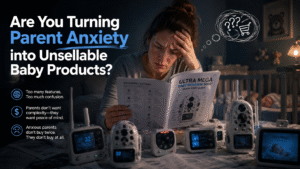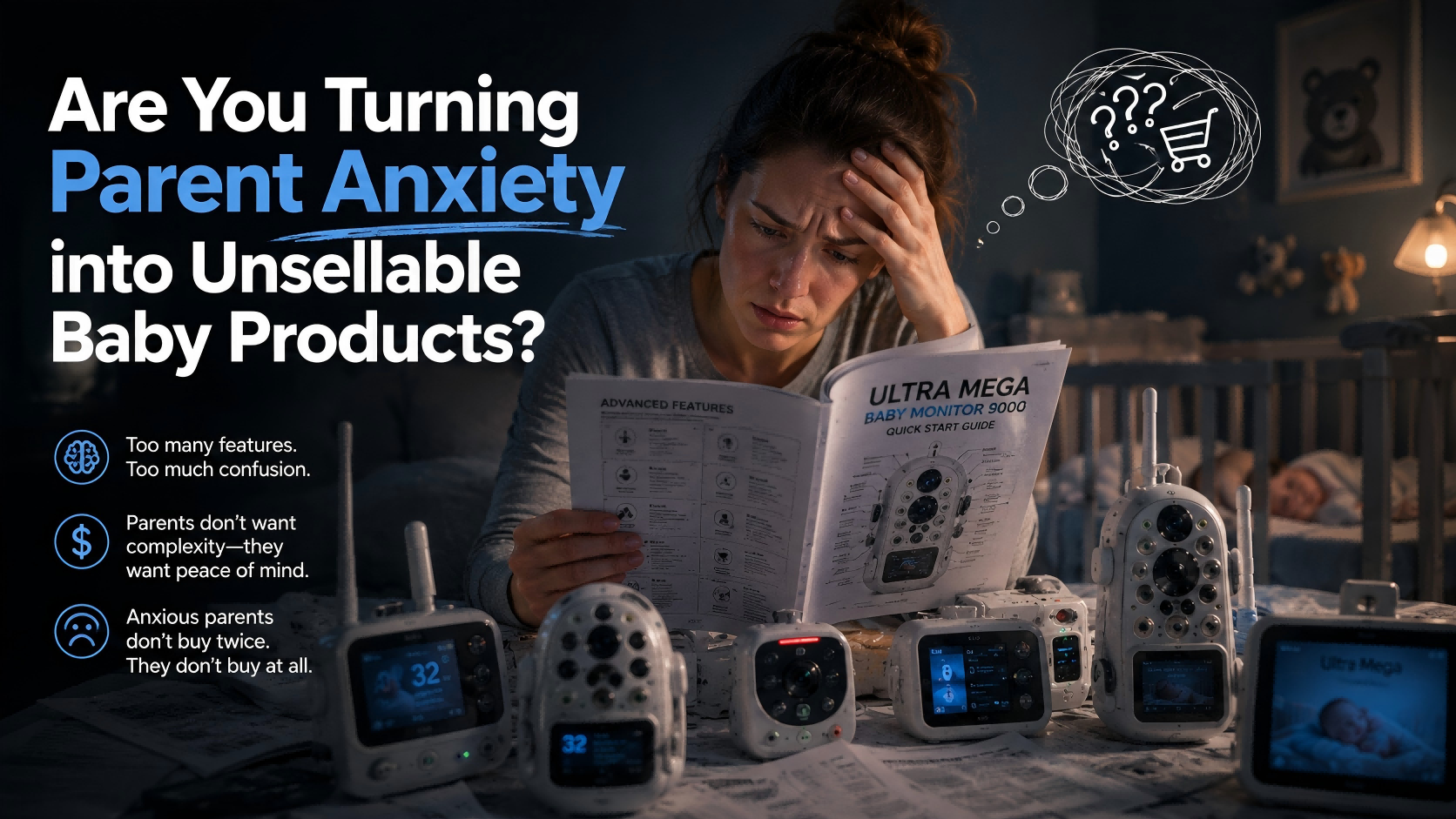
Your baby hardware isn't selling as expected. You added all the 'right' features, but missed the real driver: parent anxiety1. Let's fix that and start defining products that resonate.
Yes, many B2B clients create unsellable products by literally adding features based on parental fears. The key is to stop adding features and start decoding the underlying risk. You must translate raw anxiety into a product attribute that credibly reduces that specific risk for modern parents.
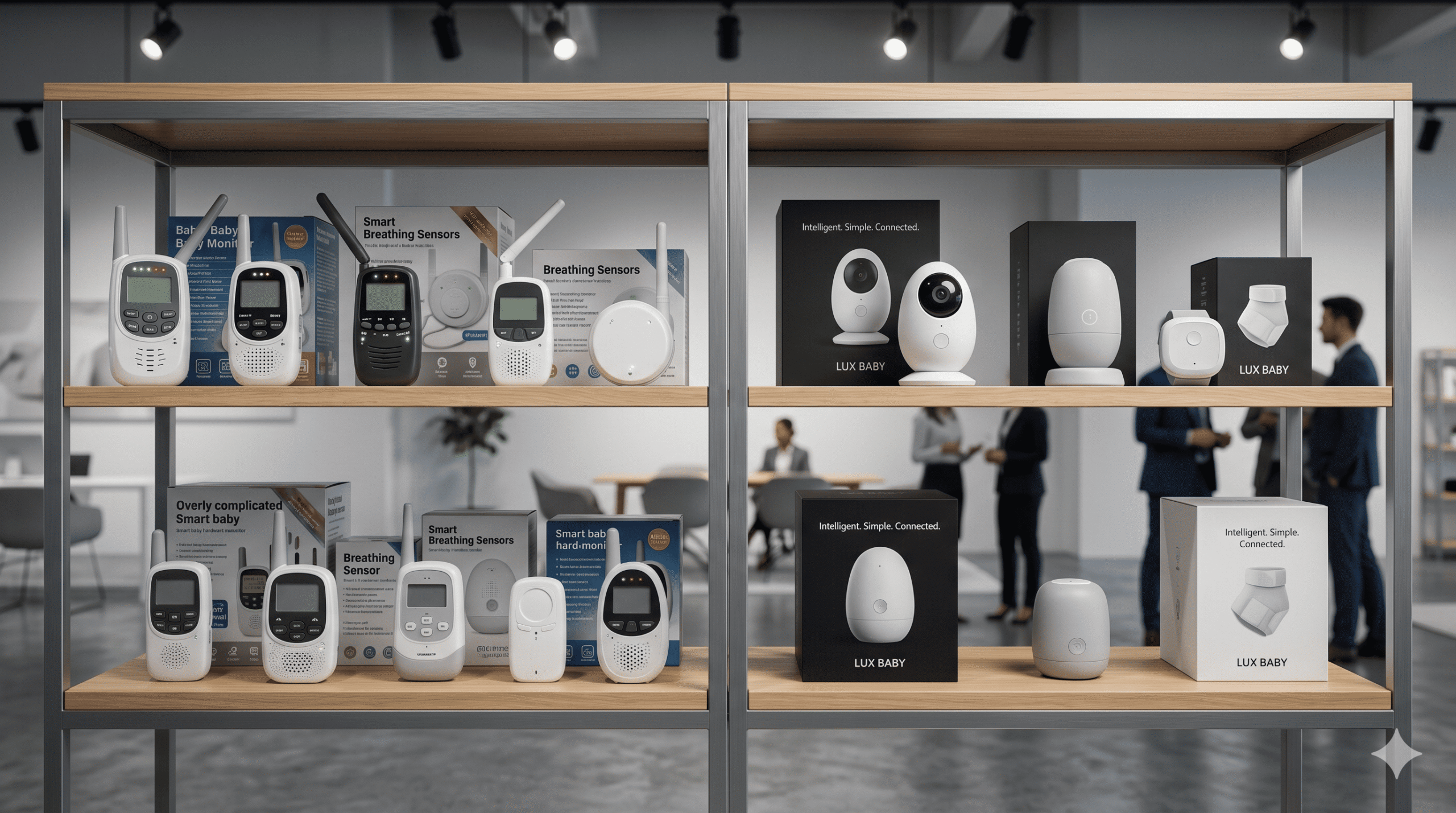
I see this happen all the time in my client conversations. A buyer comes to me with a list of features copied from a competitor, thinking it's a surefire hit. But they’ve skipped the most crucial step: understanding the emotional journey of their end-customer. It's a classic case of mistranslation, and it's where good intentions turn into warehouse deadstock. Before you finalize your next product brief, let’s walk through how this goes wrong, and more importantly, how to get it right.
Why Does Copying Bestseller Features Fail So Often?
You see a bestseller with 10 features and decide to copy them. But your product flops. Why doesn't this simple strategy work? The answer is in the translation.
Copying features fails because you're mimicking the 'what' without understanding the 'why'. A bestseller's features aren't a random list; they are specific answers to parental anxieties2. Your product fails when your copied features don't align with the anxieties of your specific target market.
A client, a buyer for a large European supermarket chain, recently asked me, "What's hot in baby monitors right now? Should we add AI cry detection?" It’s a typical question. My response was, "Let's pause. What specific fear are we trying to solve for your customer?" They were just looking for the next feature to put on their product listing. They hadn't considered why a parent would want that feature. This is the translation failure in action. They see a feature, assume it's valuable, and add it to a spec sheet without understanding the core problem it solves.
Here’s how we broke this down together to build a better product brief:
| Parent's Raw Anxiety | Bad Translation (Just Adding a Feature) | Good Translation (Mitigating a Specific Risk) |
|---|---|---|
| "I can't be there 24/7." | "Add a 1080p camera." | "Provide a reliable, low-latency video feed3 for peace of mind." |
| "What if the baby is just fussy, not in real trouble?" | "Add AI cry detection." | "Offer differentiated alerts to reduce the parent's alarm fatigue4." |
By reframing the conversation from features to risk, we built a product brief that addressed real concerns, not just marketing buzzwords.
Are Your Products Designed for Lifestyles That No Longer Exist?
Your product is designed for a perfect nursery. But modern families are mobile and work from home5. Your product can become useless outside that one specific room. Let's fix this.
Yes, many products fail because they are built for outdated, 'traditional nursery' scenarios. New-gen parents need products that fit fragmented lifestyles6, like remote work and multi-location childcare. The product's value is determined by its flexibility across different contexts, not just its performance in one.

I had a conversation with an entrepreneur client developing a new baby food warmer. Their design was perfect for a kitchen counter. It assumed a parent would always be home in a traditional setting to prepare a bottle. I asked them, "What happens when the parent is in the car, at a grandparent's house, or juggling a Zoom call in their home office?" The product was based on a lifestyle that is becoming less common. The reality for many parents in the Middle Eastern and European markets I serve looks very different today.
The Shift in Parenting Context
- Then: One parent stayed at home with a fixed schedule in a dedicated nursery7. Products were designed for stationary, single-location use.
- Now: Both parents may work remotely, or childcare is split between locations8. Schedules are fluid. Parents need to "maintain a parenting presence" even when busy or in a different room.
This shift means a portable bottle warmer that holds a charge is often more valuable than a stationary one with ten temperature settings. Your product definition must prioritize contextual flexibility over a long list of features for a single, ideal scenario.
How Can You Decode Parent Anxiety Without Creating New Problems?
You tried to address a safety concern, but your solution is too complex. Now the parent is anxious about using it wrong. You have just traded one anxiety for another.
Decode anxiety in three steps: identify the raw fear, define the specific risk it creates, and then select one product attribute that credibly reduces that risk. The key is simplicity. A solution that is too complex or creates new doubts will be rejected by the parent.
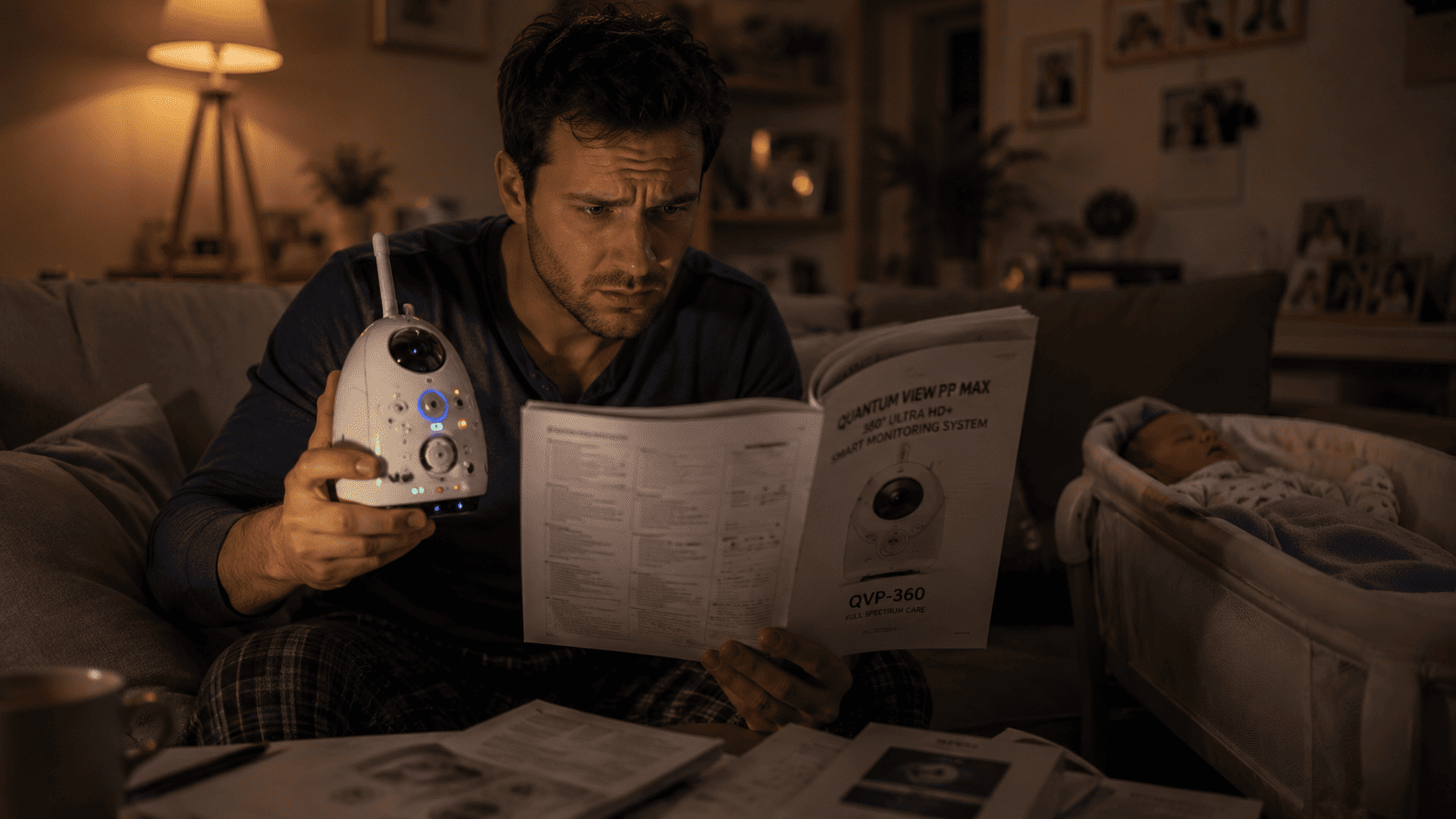
In my work, I help clients avoid a common trap: solving one anxiety by creating another. A product packed with safety features can make a parent feel irresponsible if they can't afford the premium version9. Or they may feel overwhelmed if they can't figure out how to use all the features. This is where the product definition breaks in the real world, at the moment of purchase or first use. I guide my clients through a simple three-step decoding process to prevent this from happening.
The Anxiety Decode Framework
- Identify Raw Anxiety: Start with the core feeling. For example, "I'm afraid my baby will stop breathing during sleep10." This is a deep, powerful fear.
- Define Specific Risk: What is the parent trying to control? "I need a way to monitor my baby's well-being without being a medical expert and staying up all night."
- Find a Credible, Simple Attribute: What's the minimum viable solution? Instead of a complex medical-grade monitor that requires calibration (creating new anxiety), it could be a smart sock that provides a simple green/red light status11. It's easy to understand and doesn't overwhelm the user.
The goal isn't to eliminate all risk12. It's to give the parent a simple, credible tool that makes them feel more in control without adding new mental burdens.
Conclusion
Stop copying features and start decoding anxiety. Understand the real risks and lifestyles of modern parents to define products that sell because they genuinely help.
"Factors Affecting Impulse Buying Behavior of Consumers - PMC - NIH", https://pmc.ncbi.nlm.nih.gov/articles/PMC8206473/. Consumer behavior research in parenting markets demonstrates that emotional factors, particularly safety concerns and anxiety reduction, are primary drivers in product selection, often outweighing functional feature comparisons. Evidence role: expert_consensus; source type: paper. Supports: that emotional factors, particularly anxiety, significantly influence parental purchasing decisions in baby product markets. Scope note: Studies typically focus on specific product categories or demographic segments rather than universal parenting behavior ↩
"[PDF] Mitigating the Negative Effects of Customer Anxiety through Access ...", https://www.hbs.edu/ris/Publication%20Files/19-089_41436e5b-f067-4040-9281-5069a1474b3d.pdf. Product development frameworks such as Jobs-to-be-Done theory establish that successful features emerge from understanding the functional, emotional, and social jobs customers are trying to accomplish, rather than from feature-list comparisons. Evidence role: mechanism; source type: research. Supports: that successful product features address underlying customer needs rather than existing as isolated attributes. Scope note: This framework applies broadly to consumer products and is not specific to parenting anxiety contexts ↩
"Modeling the Impacts of Swipe Delay on User Quality of Experience ...", https://arxiv.org/html/2603.18575v1. Human-computer interaction research demonstrates that latency in real-time video monitoring systems affects user confidence and response time, with delays exceeding 1-2 seconds significantly impacting perceived reliability and usefulness. Evidence role: mechanism; source type: research. Supports: that reduced latency in video monitoring improves user confidence and response effectiveness. Scope note: Most research focuses on professional monitoring contexts rather than consumer parenting applications ↩
"Alarm fatigue in healthcare: a scoping review of definitions ... - PMC", https://pmc.ncbi.nlm.nih.gov/articles/PMC12181921/. Alarm fatigue, extensively documented in healthcare settings, occurs when frequent alerts—particularly false positives—lead to desensitization, delayed responses, or complete disregard of warnings. Evidence role: mechanism; source type: paper. Supports: that repeated exposure to non-critical alerts can lead to desensitization and delayed response. Scope note: Most alarm fatigue research focuses on clinical healthcare environments rather than consumer home monitoring contexts ↩
"Do working parents in the United States expect work location ... - PMC", https://pmc.ncbi.nlm.nih.gov/articles/PMC10989322/. Labor statistics from multiple developed nations show significant increases in remote work arrangements among parents following 2020, with many households maintaining hybrid or fully remote work patterns. Evidence role: statistic; source type: government. Supports: that remote work among parents increased substantially in recent years. Scope note: Remote work prevalence varies significantly by country, industry, and socioeconomic status ↩
"Parenthood and Well-Being: A Decade in Review - PMC", https://pmc.ncbi.nlm.nih.gov/articles/PMC7326370/. Time-use studies and family sociology research document that contemporary dual-career households manage childcare across multiple locations and caregivers, with less predictable daily routines than previous generations. Evidence role: general_support; source type: research. Supports: that contemporary parenting involves managing multiple locations, schedules, and caregiving arrangements. Scope note: These patterns are most pronounced in urban, middle-to-upper income households in developed economies ↩
"Mothers' employment has surpassed pre-pandemic levels, but the ...", http://blog.dol.gov/2024/05/06/mothers-employment-has-surpassed-pre-pandemic-levels-but-the-child-care-crisis-persists. Labor force participation data shows that in mid-20th century developed nations, single-earner households with one stay-at-home parent were the statistical norm, whereas dual-earner households have become predominant since the 1970s-1980s. Evidence role: historical_context; source type: government. Supports: that single-earner households with one stay-at-home parent were more common in mid-20th century developed nations. Scope note: This pattern varied significantly by socioeconomic class, race, and geographic region even during peak single-earner periods ↩
"Fast Facts: Child care (4)", https://nces.ed.gov/fastfacts/display.asp?id=4. Family demography research indicates that contemporary households increasingly rely on multiple childcare arrangements, including grandparents, daycare facilities, and split-household care, rather than single-location care. Evidence role: general_support; source type: research. Supports: that contemporary families utilize multiple childcare locations and providers. Scope note: Childcare arrangement patterns vary significantly by family structure, income level, and cultural context ↩
"Direct-to-Consumer Marketing for Parent-Child Interaction Therapy", https://pmc.ncbi.nlm.nih.gov/articles/PMC7728243/. Consumer psychology research on parenting products demonstrates that safety-focused marketing can inadvertently increase parental anxiety and guilt, particularly among lower-income consumers who perceive premium safety features as necessary but unaffordable. Evidence role: mechanism; source type: paper. Supports: that marketing emphasizing child safety can create anxiety and guilt in consumers unable to purchase premium options. Scope note: Research on this specific mechanism in parenting contexts is limited compared to broader consumer guilt studies ↩
"The psychological consequences of Sudden Infant Death Syndrome ...", https://pmc.ncbi.nlm.nih.gov/articles/PMC9995968/. Pediatric and parenting psychology research consistently identifies fear of sudden infant death syndrome (SIDS) and breathing cessation as among the most common and intense anxieties reported by new parents, particularly during the first six months. Evidence role: expert_consensus; source type: paper. Supports: that fear of sudden infant death syndrome and breathing cessation is a prevalent anxiety among new parents. ↩
"Media Review: The Owlet Smart Sock—a “must have” for the baby ...", https://pmc.ncbi.nlm.nih.gov/articles/PMC7849797/. Consumer infant monitoring products utilizing sock-worn pulse oximetry sensors with simplified visual status indicators (such as color-coded lights) have been commercially available since the mid-2010s. Evidence role: case_reference; source type: other. Supports: that consumer infant monitoring devices using sock-worn sensors with simplified status displays exist in the market. Scope note: Medical efficacy and FDA regulatory status of such consumer devices varies and has been subject to ongoing debate ↩
"Parenting and Child Development: A Relational Health Perspective", https://pmc.ncbi.nlm.nih.gov/articles/PMC7781063/. Child development research and parenting psychology literature establish that developmentally appropriate risk exposure is beneficial for children, and that parenting strategies focused on risk management rather than elimination support healthier outcomes than overprotective approaches. Evidence role: expert_consensus; source type: paper. Supports: that appropriate parenting involves managing rather than eliminating all risks, as some risk exposure supports child development. ↩