The 'smart nursery' sounds great, promising a seamless, connected experience for new parents. But this dream can quickly become your retail nightmare, leaving you with angry customers and complex problems.
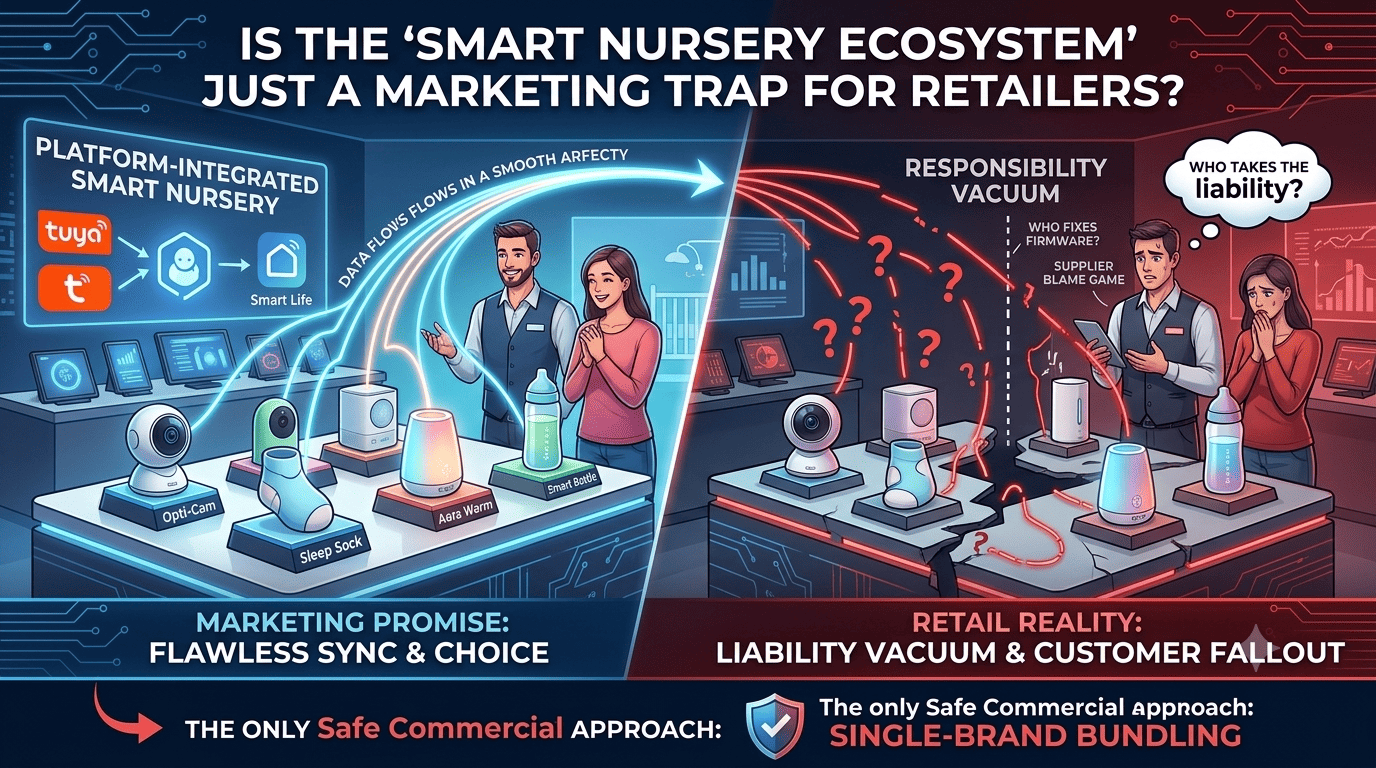
The promise of a 'platform-integrated smart nursery' is often a marketing claim that fails in the real world.1 It shifts technical risks and after-sales liability onto you, the retailer. The only commercially viable approach is single-brand bundling, which guarantees one point of contact and clear responsibility.
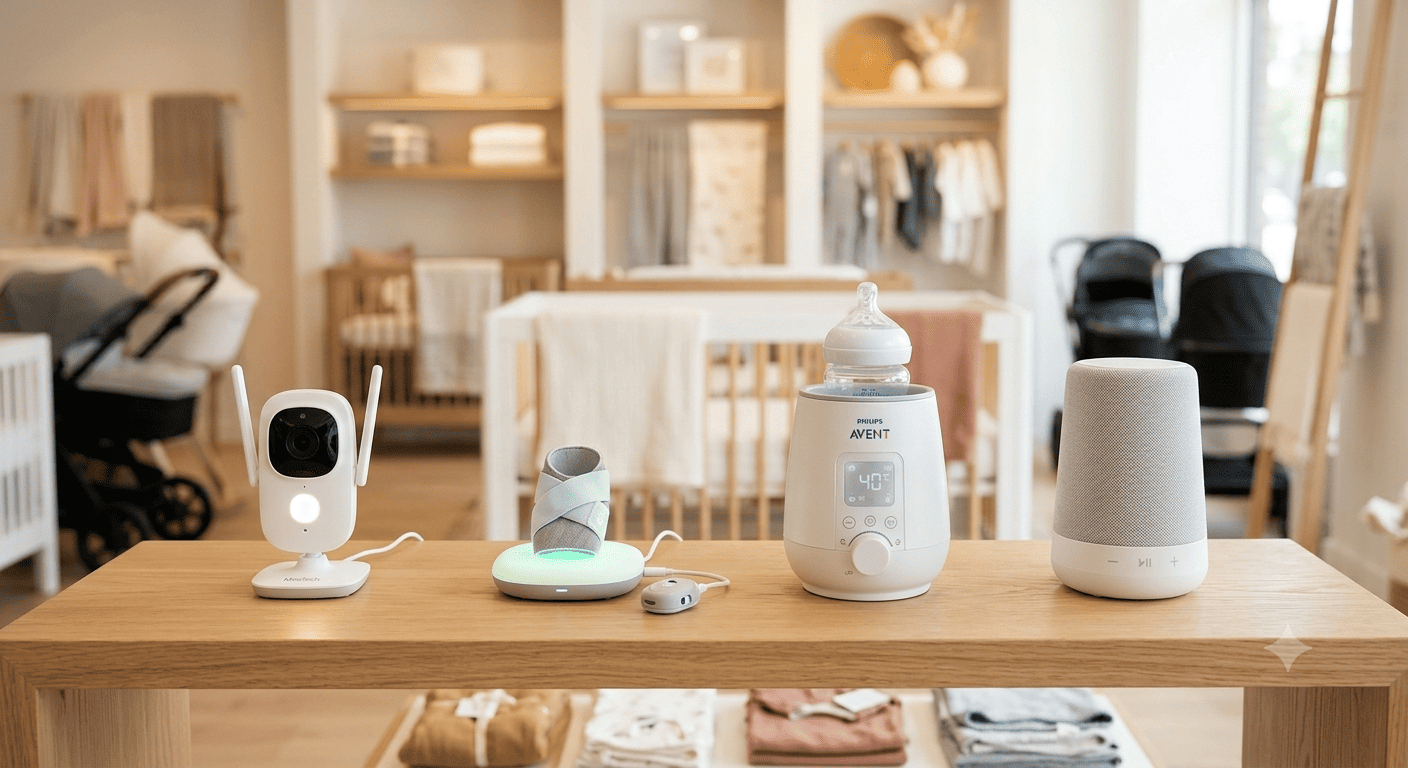
I’ve sat in countless negotiation rooms with buyers just like you, from large supermarket chains in Europe to ambitious entrepreneurs in the Middle East. We've all seen the slick vendor presentations showing a dozen different smart baby products all working together in perfect harmony. But I’ve also seen the fallout when that fantasy meets reality on the store shelf and in the customer's home. The real conversation isn't about cool features; it's about who takes the blame when things go wrong. Let's break down the risks that vendors conveniently leave out of their pitch decks, so you can protect your business and your customers.
Will Different Smart Baby Brands Actually Work Together on One Platform?
You find a great camera from Brand A and a popular smart soother from Brand B. Both suppliers promise they work on the same app. This seems like a perfect way to offer choice, but it’s a setup for failure.
In my experience, different brands rarely work together seamlessly for long.2 'Platform compatible' is not a guarantee. It’s often a procurement trap that leads to vendor lock-in or leaves your customers with devices that won't communicate.
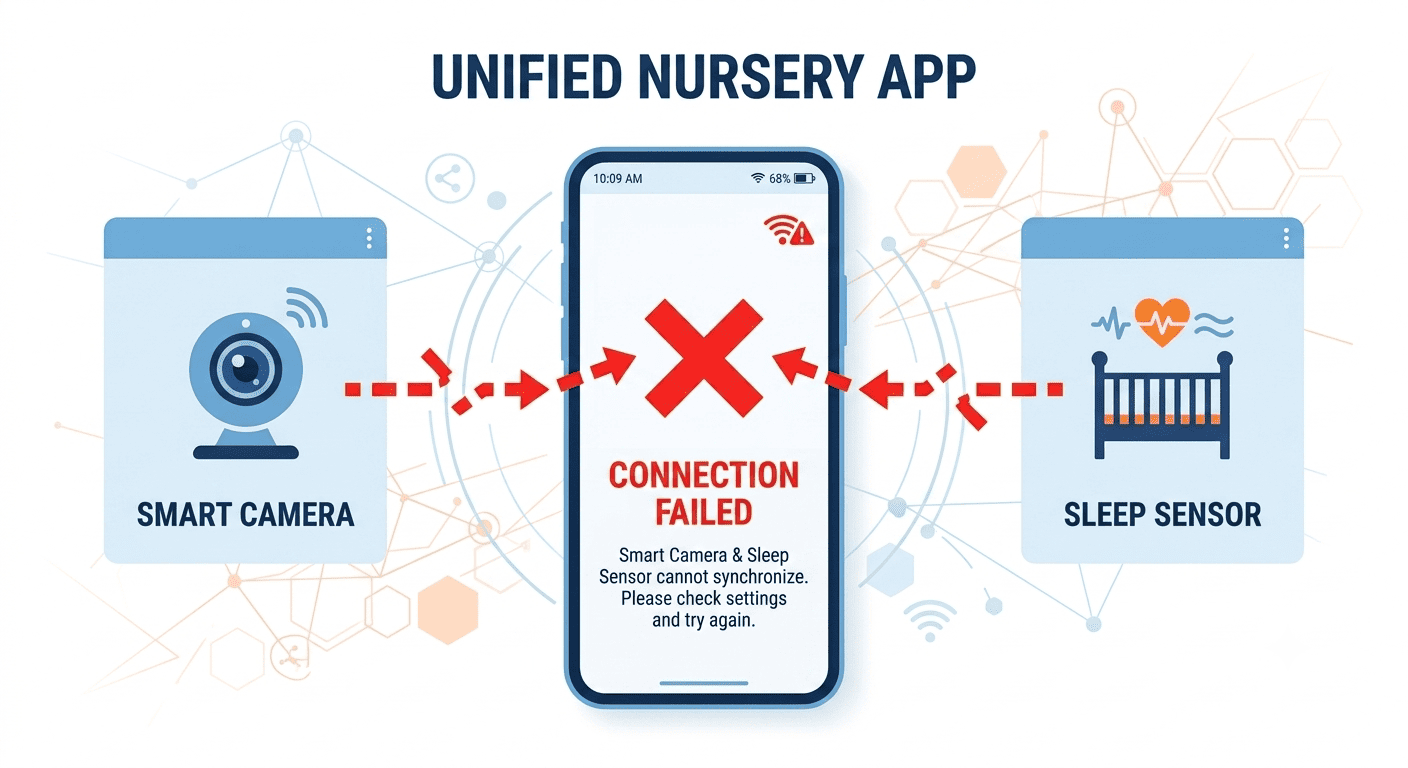
I was recently helping a client source their first smart nursery range. They wanted to pick the "best" product from each category: a camera from one factory, a breathing monitor from another. The spec sheets all proudly displayed logos for "Tuya3" or "Smart Life," suggesting universal compatibility. My client assumed this meant they could mix and match freely. I stopped the process and asked the vendors a simple question: "Who guarantees that your camera will still work with this other sensor after you push a firmware update next year?" The room went silent. This is the core problem. "Compatible" on paper today doesn't mean "supported" in practice tomorrow. Each vendor is only responsible for their own device. When an update from one brand breaks the connection to another, you are left in a responsibility vacuum. No single supplier is contractually liable for the failure of the system.
Here's how the vendor promise translates into procurement reality:
| Vendor Promise | Procurement Reality |
|---|---|
| "Platform Compatible" | Often means using different, incompatible versions of the same base protocol.4 |
| "Easy Integration" | Requires technical debugging that neither you nor your customer can perform. |
| "Offers Buyer Choice" | Creates a customer support nightmare where you are the only point of contact. |
This isn’t a technology issue; it's a liability issue. Your purchase contract needs to define who is responsible for the connection between devices, not just the function of a single device.
Who Is Responsible When Your 'Complete Smart Nursery Suite' Fails?
Offering a "complete smart nursery suite" by mixing brands sounds like a fantastic sales strategy. But when a customer calls you because their smart sock won't sync with their smart mobile, who handles the problem? You do.
When you mix brands to create a 'suite,' no single party takes responsibility for the overall system. Vendors will blame each other, leaving you caught in the middle to manage customer complaints, returns, and damage to your store's reputation.
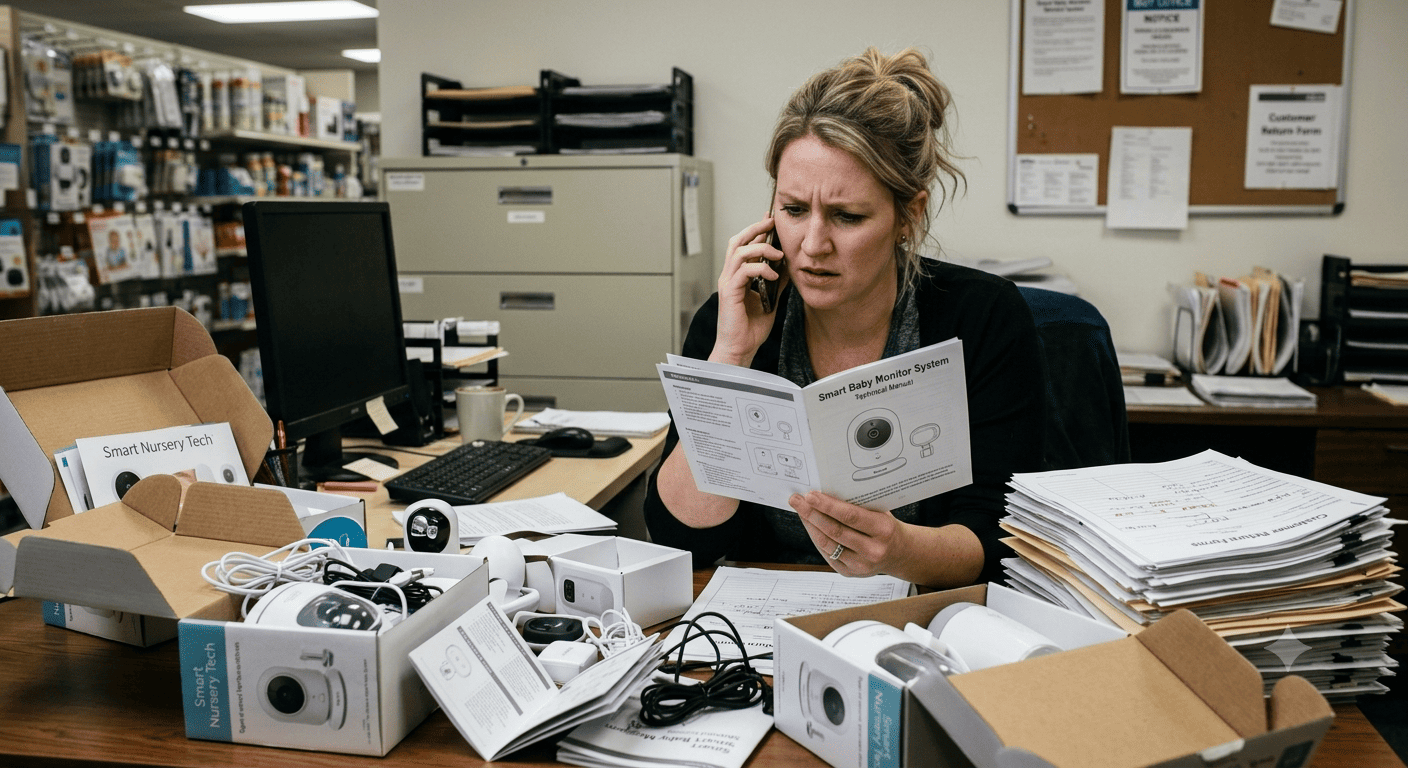
Buyers consistently underestimate the true cost of this strategy. You see it as adding another product SKU to your inventory. From my experience, I can tell you it's a commitment to supporting a complex tech ecosystem. One of my clients, a supermarket procurement manager, perfectly captured the issue when she asked me, "If I stock this smart air purifier and that smart baby monitor, who is going to write the instructions to make them work together?" The answer is nobody. Your staff are not IoT technicians.5 Yet they will be the ones facing angry customers demanding a solution. You end up absorbing all the hidden costs.
These hidden costs include:
- Increased Customer Support: Your team will spend hours trying to solve technical problems they aren't trained for.
- Expensive Staff Training: You have to teach your sales staff how to be amateur IT support for a dozen different products.
- Higher Return Rates6: You'll process returns for products that work perfectly fine on their own but fail as a "system." The reason for return will be "defective," even when it's a compatibility issue.
- Reputation Damage: You risk becoming the store that sells complicated gadgets that don't deliver on their promise.7
When you source a multi-brand solution, you are implicitly agreeing to become the system integrator8 and the ultimate support line.
Are You Comparing Product Features or Mapping Supplier Responsibilities?
You're in a negotiation, and you have two spec sheets for smart baby monitors. You're comparing camera resolution, battery life, and night vision range. But you're missing the most important questions.
The critical decision is not about features; it's about responsibility.9 You must ask who debugs compatibility issues, who manages cross-device firmware updates, and who pays for the warranty claim when two products fail to connect with each other.
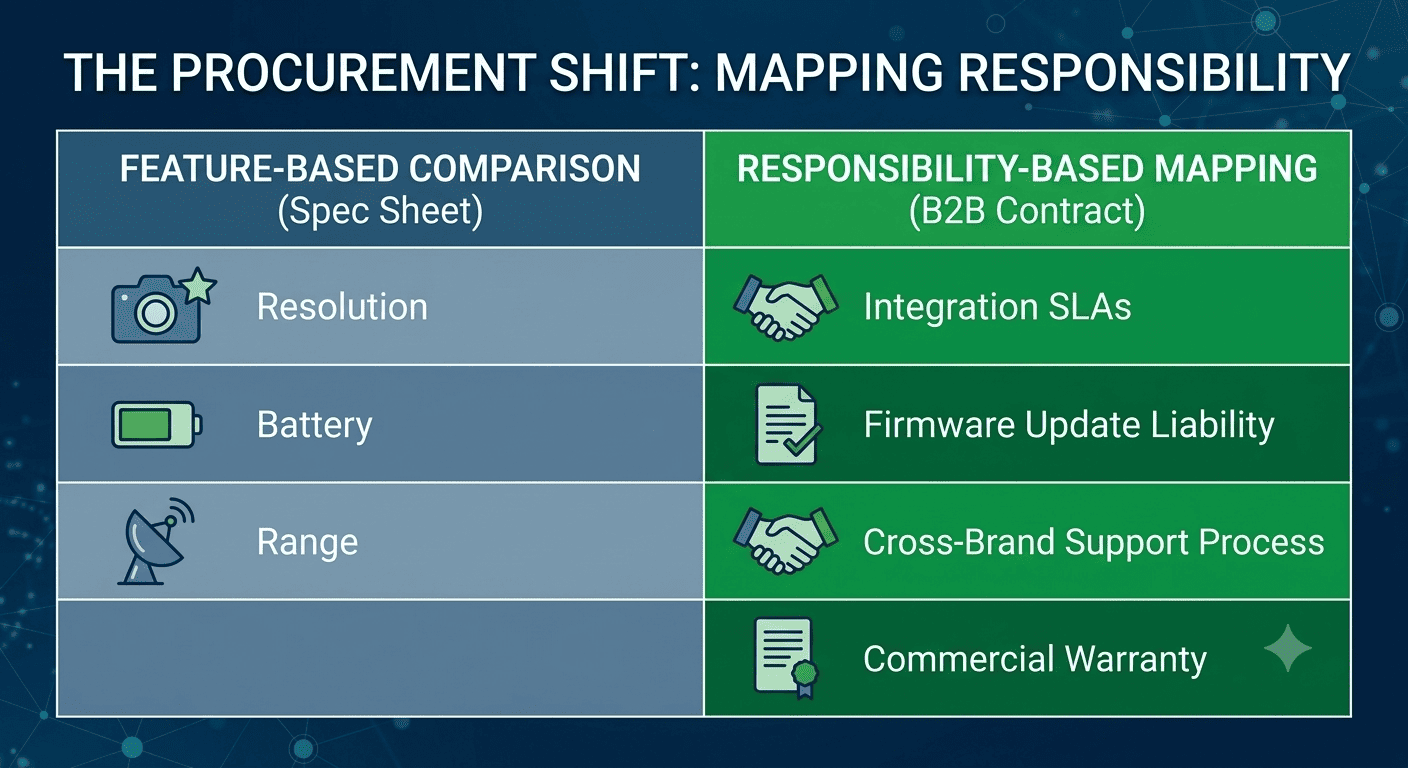
You need to shift your mindset from comparing products to comparing suppliers' commitment to support. During a factory audit for a major European retailer, I had the lead engineers from two different "compatible" smart nursery suppliers in the same room. I asked them to draw a workflow diagram showing how a customer's complaint about their devices not syncing would be resolved. They could not agree on who was responsible for the first step, let alone the entire process. This isn't a detail to be worked out later; it's a fundamental flaw in the business model. Before you sign any contract, ask your supplier these questions and demand the answers be put in writing:
- Integration Service Level Agreement (SLA)10: What is your guaranteed level of service for maintaining compatibility with Brand X's device, and what are the penalties if you fail?
- Firmware Update Policy11: If Brand X pushes an update that breaks compatibility, is your product's warranty still valid? Who is responsible for creating and deploying a patch?
- Support & Escalation Process: Who is the first point of contact for an integration issue? What is your documented process for collaborating with the other vendor to find a solution?
- Commercial Liability: If a customer returns the entire "smart nursery" package because of an integration failure, which vendor reimburses us for the cost of all the products?
If a supplier avoids answering these questions, they are selling you a standalone box, not a connected solution. They are transferring all the real-world ecosystem risk directly to you.
Conclusion
Avoid the "platform" marketing trap. The only safe and commercially sound way to enter the smart nursery market is to partner with a single brand that offers a complete, vertically integrated bundle.12
"Breaking Down the Compatibility Problem in Smart Homes - PMC", https://pmc.ncbi.nlm.nih.gov/articles/PMC7285766/. Research on smart home ecosystems has documented persistent interoperability challenges, with studies showing that cross-brand device integration frequently fails to meet consumer expectations despite marketing claims of compatibility. Evidence role: general_support; source type: research. Supports: that IoT device interoperability remains a documented challenge in consumer markets. Scope note: General IoT interoperability research may not specifically focus on nursery products, though the technical challenges are analogous across consumer IoT categories. ↩
"Breaking Down the Compatibility Problem in Smart Homes - PMC", https://pmc.ncbi.nlm.nih.gov/articles/PMC7285766/. Technical analyses of IoT ecosystems have identified firmware update cycles as a primary source of compatibility degradation, as vendors prioritize their own product roadmaps over maintaining third-party integrations. Evidence role: mechanism; source type: research. Supports: that firmware updates and platform evolution create ongoing compatibility challenges in multi-vendor IoT ecosystems. Scope note: This describes the technical mechanism rather than providing specific failure rate statistics for smart nursery products. ↩
"Tuya Inc. - Wikipedia", https://en.wikipedia.org/wiki/Tuya_Inc.. Tuya is a global IoT development platform that provides cloud services and app infrastructure for smart device manufacturers, enabling products from different vendors to theoretically share common connectivity protocols. Evidence role: definition; source type: encyclopedia. Supports: that Tuya is a Chinese IoT cloud platform provider that enables smart device connectivity. ↩
"Breaking Down the Compatibility Problem in Smart Homes - PMC", https://pmc.ncbi.nlm.nih.gov/articles/PMC7285766/. Technical documentation of IoT communication protocols reveals that devices claiming compatibility may implement different protocol versions or optional feature sets, creating functional incompatibilities despite nominal adherence to the same standard. Evidence role: mechanism; source type: research. Supports: that protocol version fragmentation is a recognized technical challenge in IoT device ecosystems. ↩
"[PDF] Washington Retail Workforce Report", https://wtb.wa.gov/wp-content/uploads/2023/12/Retail-Workforce-Analysis-Report.pdf. Studies of retail workforce training indicate that frontline staff generally receive product knowledge training focused on features and sales rather than technical troubleshooting, particularly for complex networked devices requiring systems-level understanding. Evidence role: general_support; source type: research. Supports: that retail employees typically receive limited technical training on complex consumer electronics troubleshooting. Scope note: This addresses general retail training patterns rather than specifically documenting IoT troubleshooting capability gaps. ↩
"Reduce Product Returns in the Consumer Electronics Industry", https://techsee.com/resources/white-papers/product-returns-avoidance-strategies/. Industry analyses of consumer electronics returns show that smart home and IoT devices consistently experience higher return rates than non-connected equivalents, with compatibility and setup difficulties cited as leading reasons for returns. Evidence role: statistic; source type: research. Supports: that consumer electronics, particularly connected devices, experience elevated return rates compared to traditional products. Scope note: Available data typically covers broad smart home categories rather than specifically isolating multi-brand versus single-brand configuration return rates. ↩
"[PDF] The Impact of Online Product Reviews on Product Returns and Net ...", https://people.bu.edu/nachi/pdf/ProductReturnsWISE2013.pdf. Consumer behavior research demonstrates that product failures and unmet expectations significantly influence retailer reputation, with customers often attributing responsibility to the point of sale rather than manufacturers, particularly for complex technical products. Evidence role: general_support; source type: research. Supports: that product performance failures negatively impact consumer perception of retailers. ↩
"products liability | Wex | US Law | LII / Legal Information Institute", https://www.law.cornell.edu/wex/products_liability. Consumer protection frameworks in major markets typically position retailers as the primary point of accountability for product performance from the customer perspective, creating practical responsibility for system-level functionality even when multiple manufacturers are involved. Evidence role: general_support; source type: other. Supports: that retailers often bear customer-facing responsibility for product ecosystem performance regardless of contractual arrangements with suppliers. Scope note: Legal frameworks vary significantly by jurisdiction, and this describes the practical customer relationship rather than specific contractual liability. ↩
"IT Vendor Risk Management - UW-IT - University of Washington", https://it.uw.edu/guides/it-sourcing-standards/it-sourcing/it-vendor-risk-management/. Supply chain management literature emphasizes that for complex technology products, clearly defined supplier responsibilities and support commitments are essential procurement criteria, often outweighing technical specifications in determining total cost of ownership and customer satisfaction outcomes. Evidence role: expert_consensus; source type: research. Supports: that risk allocation and supplier accountability are critical factors in technology product procurement. ↩
"What is an SLA: SLA Meaning & Examples | Atlassian", https://www.atlassian.com/itsm/service-request-management/slas. Service Level Agreements (SLAs) are contractual instruments that specify measurable service performance commitments, monitoring mechanisms, and remediation procedures, commonly used in IT service management to establish clear accountability for system performance and availability. Evidence role: definition; source type: education. Supports: that Service Level Agreements are formal contracts defining expected service performance and remedies. Scope note: While SLAs are standard in IT services, their application to consumer product integration support represents an extension of this framework rather than established industry practice. ↩
"Software and Firmware Update - NIST Pages", https://pages.nist.gov/FederalProfile-8259A/nontechnical/update/. Technical literature on IoT device management identifies firmware update policies as essential governance mechanisms, as updates can introduce security patches, new features, or protocol changes that may affect device interoperability and require coordinated deployment strategies in multi-device ecosystems. Evidence role: mechanism; source type: research. Supports: that firmware update management is a critical aspect of IoT device lifecycle and compatibility maintenance. ↩
"What is vertical integration in companies? – Beyond Esade", https://www.esade.edu/beyond/en/vertical-integration-companies/. Business analyses of consumer technology markets have documented that vertically integrated, single-vendor ecosystems can reduce support complexity and provide clearer accountability, though this approach also limits consumer choice and may create vendor lock-in effects. Evidence role: general_support; source type: research. Supports: that vertical integration and single-vendor ecosystems offer advantages in product support and customer experience for complex technology products. Scope note: This describes general strategic trade-offs rather than proving that single-brand approaches are the 'only' viable strategy, as successful multi-vendor approaches also exist in various market contexts. ↩