1. A Brief History of Child Car Seats
In the early days, child car seats were primarily designed to raise a child’s seating position for better visibility, with minimal safety considerations. In 1933, the Bunny Bear Company launched one of the earliest commercial “basket-style” seats, designed to elevate children so they could look out of the window [38†L210-L218].
By the 1960s, true safety-oriented designs began to emerge. In 1962, British journalist Jean Ames invented a rear-facing seat to protect the child’s neck, while American Leonard Rivkin developed a forward-facing model with a metal frame and five-point harness to restrain the child in the back seat [38†L235-L242]. During the same period, Scandinavian countries, led by Sweden, began advocating for extended rear-facing use—a philosophy now widely endorsed for its superior protection of the head and spine.
In the 1970s, governments and automakers started formalizing regulations. In 1971, the U.S. National Highway Traffic Safety Administration (NHTSA) mandated that all child restraints must be secured with the vehicle’s seat belts [35†L190-L197]. Soon after, Europe and other countries followed suit with mandatory safety testing protocols. By 1982, the European ECE R44 standard categorized seats by group (0/I/II/III) and set performance benchmarks. Japan issued TRIAS 51 in 1999, and China implemented the CCC certification in 2015, referencing ECE R44/04 [1†L95-L100].
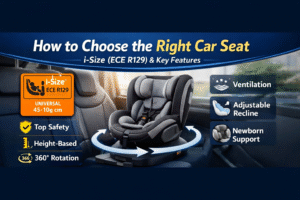
Since the late 1990s, technical innovation accelerated. ISOFIX, introduced in 1997 (Europe), and LATCH in 2002 (U.S.), standardized anchoring systems for easier and safer installation [35†L241-L248]. In 2013, the EU rolled out ECE R129 (i-Size), a new regulation requiring:
-
Height-based classification,
-
Mandatory ISOFIX installation,
-
Rear-facing until at least 15 months,
-
Side-impact testing.
Today’s car seats incorporate advanced features such as:
-
360° swivel mechanisms
-
Modular growth systems
-
Smart sensors for installation status or child presence alerts.
As consumer demand has shifted from basic functionality to “smarter, safer, and more user-friendly” designs, brands are investing in improved engineering, comfort materials, and integrated tech.
![Image] A 1930s Bunny Bear-style booster: designed for viewing, not protection. Modern designs prioritize safety, impact absorption, and certified installation systems.
2. Child Seat Types by Age Group
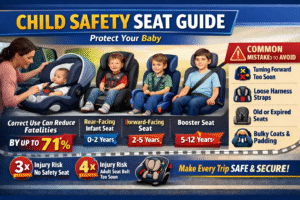
Choosing the right seat depends on a child’s age, height, and weight. The chart below outlines typical seat categories and functions:
| Age Group | Weight/Height Range | Seat Type | Key Features |
|---|---|---|---|
| Newborn (0–1 yr) | 0–13 kg / up to 75 cm | Rear-facing Infant Carrier (Basket-style) | Lightweight, portable, deep recline for head support |
| Infant–Toddler (1–4 yrs) | 9–18 kg / up to 105 cm | Convertible or 0+/1 Seat | Starts rear-facing, later forward-facing, 5-point harness |
| Child (4–11 yrs) | 15–36 kg / up to 145 cm | Booster Seat (with or without backrest) | Raises seat height to align vehicle belt correctly |
| Pre-Teen (11+ yrs) | 36+ kg / >145 cm | Adult seat belt (rear seat) | No child seat needed if seat belt fits properly |
Always prioritize height and fit over age when selecting a seat, as regulation and safety bodies recommend fitting based on physical development rather than just years of age [50†L1-L8].
3. Procurement and Product Selection Guide
a. Match Product to Regulatory & Consumer Preferences
Different countries and regions have distinct safety regulations and cultural preferences:
-
EU (R129): Mandatory ISOFIX, rear-facing under 15 months, side-impact protection, and height-based sizing [7†L40-L44].
-
USA (FMVSS 213): Emphasizes weight-based groupings and LATCH (UAS) anchoring. American buyers tend to favor convertible seats with extended rear-facing [1†L125-L128].
-
China/Asia: Often follow ECE R44 or GB standards. Parents in Asia prioritize convenience, aesthetic appeal, and multifunctionality.
Understanding the target market’s legislation and buyer behavior is essential. Some markets value lightweight, travel-friendly designs (e.g., Japan), while others focus on premium, smart features (e.g., China’s growing middle class).
b. Evaluate Structure, Certifications & Usability
When sourcing from OEM/ODM suppliers, prioritize models with:
-
Robust frame: Metal or high-grade plastic, shock-absorbing, energy-dispersing design.
-
Certifications:
-
Europe: ECE R44/04 or R129
-
U.S.: FMVSS 213
-
China: CCC
-
Independent: ADAC, Stiftung Warentest, or crash test reports.
-
-
Installation system: ISOFIX/LATCH options ensure ease and stability.
-
Comfort & Maintenance:
-
Breathable, flame-retardant, washable covers
-
One-hand recline, rotating base, adjustable headrest
-
-
Smart features: Sensor alarms for unbuckled belts or child detection—valuable in high-end segments.
c. Choosing the Right OEM/ODM Manufacturer
Procurement officers targeting private-label programs should assess:
-
Certifications: Verify the supplier has CCC, CE, FMVSS, or other relevant safety certifications.
-
Production qualifications: ISO9001, IATF16949, factory audits, and equipment (e.g., internal crash test labs).
-
Customization capacity:
-
Engineering & design team
-
Logo/branding options
-
Regulatory adaptation for target countries
-
-
Production scalability: High-volume output, export experience, flexible logistics.
It’s strongly recommended to request third-party safety test reports and samples, and to pilot orders with regulatory documentation (e.g., user manuals, compliance labels).
4. Summary Charts
Child Seat Categories by Growth Stage:
| Group | Approx. Age | Direction | Installation |
|---|---|---|---|
| Group 0+ | 0–12 months | Rear-facing | ISOFIX or seat belt |
| Group 1 | 1–4 years | Rear/Forward-facing | ISOFIX preferred |
| Group 2 | 4–7 years | Forward-facing (booster) | Car seat belt |
| Group 3 | 7–12 years | Booster seat | Car seat belt |
Regulation Milestone Timeline:
| Year | Event |
|---|---|
| 1933 | Bunny Bear basket seat released |
| 1962 | First modern safety seat (Jean Ames / Leonard Rivkin) |
| 1971 | NHTSA mandates safety belts for child seats (U.S.) |
| 1982 | ECE R44 implemented in Europe |
| 1997 | ISOFIX anchoring introduced |
| 2002 | U.S. mandates LATCH system |
| 2013 | EU R129 regulation enforced |
| 2015 | China adopts CCC certification for car seats |
Conclusion
Understanding the evolution of child car seats helps procurement professionals make informed decisions. When selecting products, you must balance:
-
Compliance with local regulations
-
User safety & comfort
-
Brand customization needs
-
Reliable OEM/ODM partnerships
As global demand for smarter, safer child transport solutions grows, sourcing high-quality, certified products will remain a top priority for every serious maternity and baby product business.