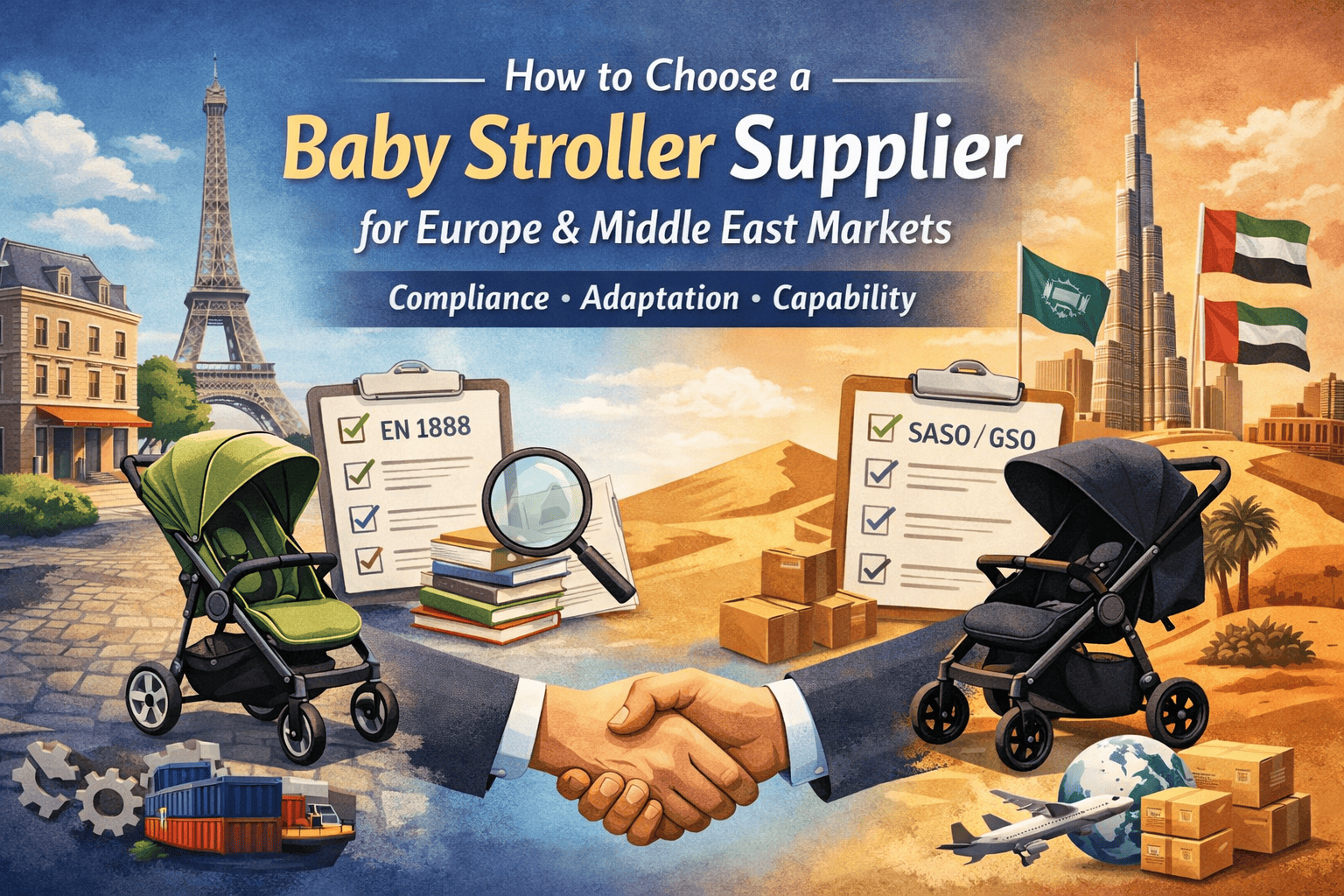
As a seasoned procurement specialist in the baby product sector for Europe and the Middle East, you know that your choice of stroller supplier is critical. It determines market access, user satisfaction, and ultimately, your profitability. Europe, with its rigorous safety standards and premium demands, and the Middle East, with its unique climate and regulatory hurdles, require distinctly different supplier selection strategies.
This guide breaks down the core differences between these markets and provides a actionable framework for selecting stroller suppliers. Learn how to navigate compliance traps and precisely match market needs.
Part 1: Core Differences – Europe vs. Middle East Market Demands
The first step is understanding the fundamental needs of each market. The divergence in safety rules, climate, and consumer preferences sets the exact entry bar for suppliers.
- Safety Compliance: Two Different “Passports to Sell”: Europe mandates the unified EN 1888 series of standards. The Middle East operates on country-specific technical regulations (e.g., Saudi’s SASO, Dubai’s GSO). Certifications are not interchangeable; suppliers must have targeted compliance capabilities.
- Environmental Adaptation: Climate Dictates Core Performance: Europe’s temperate climate prioritizes portability and suspension. The Middle East’s extreme heat, dryness, and sand demand high-temperature resistant materials and designs that offer UV protection and dust prevention.
- Consumer Preference: Premium Quality vs. Practical Durability: Europe favors minimalist design, eco-materials, and smart features (e.g., posture monitoring). The Middle East values durability, large storage, value-for-money, and has specific requirements for bilingual labeling (Arabic/English) and packaging.
Part 2: Selecting Suppliers for Europe: Compliance First, Quality is King
Europe is a mature, high-end market where EN 1888-1:2018+A1:2022 is non-negotiable. Beyond this, focus on a supplier’s quality control and design prowess.
1. The Non-Negotiable: Verifying Compliance Credentials Products without proper EU certification risk being delisted, seized, or recalled.
- Complete Core Certification: Insist on the full EN 1888-1 test report covering mechanical safety, chemical tests, and labeling. Verify key limits: lead migration ≤13.5mg/kg, cadmium ≤3.4mg/kg. Confirm folding mechanisms pass 200-cycle tests and have dual locking.
- Authorized Testing Bodies: Reports must be from EU Notified Bodies (e.g., SGS, BV) with CNAS/CMA accreditation. Avoid non-recognized labs. Note: Platforms like Amazon require annual report updates.
- Extra Compliance for Special Models: For all-terrain strollers, ensure they meet the new EN 1888-3:2024 standard for automatic brakes and 100,000-wheel impact tests.
Buyer Beware: A Shenzhen supplier faced a 3-month delay due to an 8mm hinge gap (within the 6-12mm danger zone). In 2024, German customs held 2000 strollers for missing German safety warnings in manuals.
2. Product Fit: Matching European Lifestyles European families frequently use public transport and enjoy the outdoors.
- Performance: Wheels must survive 72,000 obstacle tests (~480 km). Brakes must remain effective after 5000 operations. Folded size should be compact for car trunks or train luggage racks.
- Materials & Design: Prioritize certified recyclable materials aligning with the “sustainable parenting” trend. Opt for clean, minimalist aesthetics. Suppliers with OEM experience for brands like Bugaboo or Britax are a plus.
- Smart Features: For the premium segment, consider suppliers offering smart monitors (posture, collision alerts)—a segment growing at 25% in export value.
3. Supplier Capabilities: Production & Quality Assurance
- Scale: Prefer factories with annual capacity ≥300,000 units (e.g., manufacturers like Joie, Welldon) to ensure stable supply.
- Quality Systems: ISO 9001 certification is essential. An in-house lab for pre-shipment tests (tip-over, 70°C heat aging for 48 hours) is a strong advantage.
- After-Sales Support: Suppliers with European service networks or agents minimize logistics costs and delays for returns/repairs.
Part 3: Selecting Suppliers for the Middle East: Navigate Compliance, Master the Climate
The Middle East (core: KSA, UAE) is high-growth but has complex compliance and unique climate challenges.
1. The Gateway: Localized Certification Requirements vary by country. Suppliers must navigate this seamlessly.
- Saudi Market (SASO): All strollers need Saber system registration for Product & Shipment CoCs (HS Code 8715).
- UAE Market (GSO/ESMA): Requires GSO certification and ESMA registration. Labels must be Arabic/English (Arabic font not smaller). Single-use plastic packaging is banned (2024).
- Chemical Safety: Must meet EN 71-3 migration limits, with enhanced flame retardancy tests for high-heat safety.
2. Product Fit: Built for Heat and Sand
- Heat-Resistant Materials: Plastic parts must pass 70°C heat aging without cracking. Fabrics should be UV-resistant, breathable, and non-toxic when hot.
- Dust-Proof Construction: Sealed wheel bearings and dust-proof gaskets in folding mechanisms are crucial to prevent jamming.
- Practical Features: Large storage baskets are key for car-centric families. Designs should avoid snags on traditional clothing like abayas.
3. Supplier Capabilities: Logistics & Localization
- Logistics Adaptability: Choose suppliers familiar with Middle East logistics, preferably offering DDP (Delivered Duty Paid) terms. Domestic hubs in Dongguan/Shenzhen can reduce dependency on costly Hong Kong storage.
- Customs Support: Suppliers must provide perfect commercial invoices, certificates of origin, and assist with local agent clearance (100% inspection rate for baby products is common).
- Flexible Production: Ability to scale quickly for volatile order patterns (peak season surges) is vital.
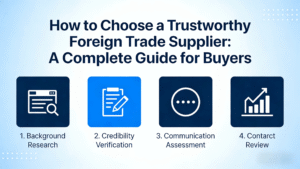
Part 4: The Universal 4-Step Supplier Screening Process
Use this framework for any market to mitigate risk:
- Initial Qualification: Request core compliance reports, business license, and production permits. Filter out unqualified workshops.
- Sample Testing: Get 2 production samples. Use a third-party lab to verify key tests (EN 1888 / SASO items). Assess craftsmanship and feature fit.
- Factory Audit: Inspect production lines, QC processes, and lab equipment. Verify true capacity and quality systems (benchmark against leaders like GB/Joie).
- Trial Order: Start with a small batch to test delivery reliability, logistics coordination, and after-sales responsiveness before scaling up.
Part 5: Conclusion: The Right Supplier is Your Competitive Edge
Choosing a stroller supplier for Europe and the Middle East hinges on “Compliance First, Adaptation is King, Capability is the Foundation.”
For Europe, laser-focus on EN 1888 certification and quality minutiae. For the Middle East, prioritize SASO/GSO compliance and superior heat/sand adaptation.
Our advice: Partner with established suppliers deeply experienced in global juvenile exports (e.g., Goodbaby, Joie, Britax China). They offer multi-market compliance mastery and robust supply chains. Remember, a premium supplier isn’t just a manufacturer—they are your strategic partner in winning overseas markets.